
How Motherhood and a Mission Led Erika Kapustinski to Sacred Heart
| 7 Min Read
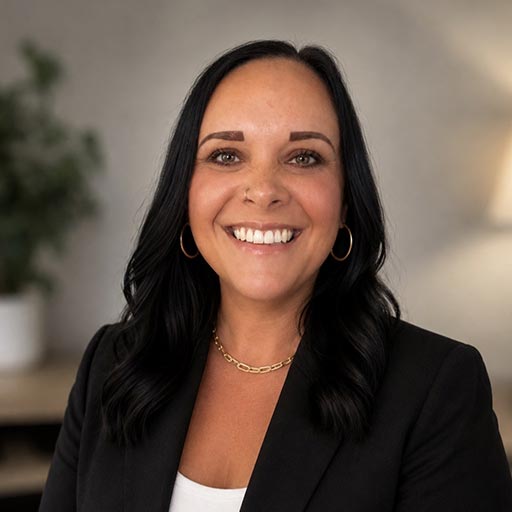
Erika Kapustinski is a single mother of five and a first-year student in Sacred Heart University’s online Master of Arts in Clinical Mental Health Counseling program. She spent her 20s dreaming of becoming a therapist, her 30s building the life that would make it possible, and at 38 she finally made the call she had been waiting nearly two decades to make.
Her story is not the traditional graduate school narrative. It is built on hard-won clarity, deliberate planning, and a purpose rooted in deeply personal experience. It speaks directly to prospective students weighing what this kind of commitment really looks like and what it can become.
A Goal Nearly Two Decades in the Making
Erika has aspired to become a therapist for most of her adult life. When circumstances finally aligned, she knew exactly where she wanted to go. “I was in my early 20s when I told myself: if I ever actually get to pursue becoming a therapist, I want to go to Sacred Heart,” she said. “At the time it felt like a pretty unreachable goal. When I was finally in a place where I could realistically pursue it, Sacred Heart was my first call.”
That resolve was grounded in research, not nostalgia. The program’s emphasis on holistic wellness and multicultural awareness — central to SHU’s approach to counseling education — aligned directly with Erika’s values.
She also knew that her specific focus, crisis and trauma work with children and adolescents, needed a program designed to support it. “The program has a meaningful emphasis in that area,” she said, “which I knew would help me grow and feel prepared going into my internship.” When it came to choosing, she trusted her instincts: “It really matters that the program you choose genuinely aligns with who you are. I went with my gut, and it felt right.”
Running a Household and a Graduate Program
Managing a rigorous two-year master’s program while raising five children as a single parent requires more than determination; it requires a system. Before classes even started, Erika sat her family down and was direct about what was coming. “I was very honest: this is going to be a lot, here’s what it’s going to look like, and we all need to come together as a team to make it work, not just me, but all of us.”
“This is a two-year program. It’s intense, but it’s going to pay off. The example I’m working to set for my kids is genuinely what pushes me through on the harder days.”
Her children have risen to meet that ask in concrete ways. “If I go into my room and shut the door because I have hours of writing ahead of me, they respect that. They’ll text me instead of knocking,” she said. At the same time, she guards against letting school consume family life entirely. She still shows up to her kids’ activities and carves out time for them deliberately. On fully packed days, she enforces a hard rule: “If a day is completely full, I don’t even open my laptop for schoolwork, even late at night. That mental boundary helps me pour into my family when I need to, so I can pour into school when that time comes.”
The sacrifice is real, and she is clear-eyed about it. She made financial arrangements before enrolling to account for the shift the program would require. But she keeps returning to the same anchor point: “This is a two-year program. It’s intense, but it’s going to pay off. The example I’m working to set for my kids is genuinely what pushes me through on the harder days.”
Support That Shows Up When It Counts
One of the features Erika values most about Sacred Heart’s Master of Arts in Clinical Mental Health Counseling is that academic rigor and faculty accessibility exist together, rather than in tension. Courses are demanding and graded with appropriate seriousness, but help is always available. “The professors are easy to reach, they make it clear they’re there to support you, and even though the courses are hard and they grade rigorously, as they should, there’s always this sense of, what do you need, how can we make this better?” That presence has a real effect: “You never feel like you’re figuring things out alone. I know I can email a professor and hear back within 24 hours.”
The program’s two required on-ground residencies added a dimension that online coursework alone cannot replicate. Going into the first residency, Erika felt genuine first-day nerves. What she found was an immediate sense of community and purpose. “We were applying the skills we’d been building in class, in person, in real time,” she said. “It was a completely different experience from sitting at a computer doing coursework.” Sacred Heart brings both program tracks together for residency — an intentional design choice that Erika appreciated. “The different perspectives really enriched the experience.” The bonds formed there have continued. “We all got very close, and that support has continued ever since.”
As she approaches practicum, the same organized support has carried through. Faculty communicate clearly throughout the placement process, hold group check-in sessions, and are responsive to questions. “Nothing feels like it comes out of nowhere,” she said. “I feel confident going into practicum. The coursework, the communication from faculty, the resources they’ve provided, it’s all built toward this point.”
A Mission Rooted in Her Own Family
Erika’s drive to work with children and adolescents is not a professional abstraction. It’s personal. Her own children navigated significant trauma after an abusive marriage, and she saw firsthand what that process looked like. “Watching them go through intensive therapy, seeing what trauma looks like up close in my own kids, it changed how I see everything.”
She also began recognizing a broader pattern in her community. “I started noticing other kids finding their way to our home. Friends of my kids who were struggling, who didn’t have a safe place to land. And I realized how much need there is, and how few resources are really available.”
Her long-term goal is to open her own practice centered on working with children and youth — one that integrates crisis work, play therapy, and EMDR, and actively removes barriers to access. “The research is clear that childhood trauma carries into adulthood and affects how people function every single day,” she said. “If I can help mitigate that, give kids the tools to process what they’ve been through, so it doesn’t define who they become as adults, that means everything to me.”
To prospective students still weighing whether the timing is right, Erika is direct: “Just do it. Take the leap. If this is what you really want, then no matter what is going on in your life, you can find a way. It’s not forever, it’s just a couple of years. If your end goal is to be a therapist or a school counselor, then push through and do it. It is so worth it.”
About Sacred Heart University’s Online Master of Arts in Clinical Mental Health Counseling
Sacred Heart University’s online Master of Arts in Clinical Mental Health Counseling is a 60-credit-hour, low-residency program built on CACREP standards. The program is designed to meet the academic requirements for counseling licensure in a majority of states and can be completed in as few as two years.
Graduates are prepared for roles in private practice, inpatient facilities, community agencies, schools, and other clinical settings. The program is housed in the Isabelle Farrington College of Education & Human Development and is accredited by CACREP.
Learn more about the online Master of Arts in Clinical Mental Health Counseling and apply today!