
Online Master’s Degree in Nursing Education
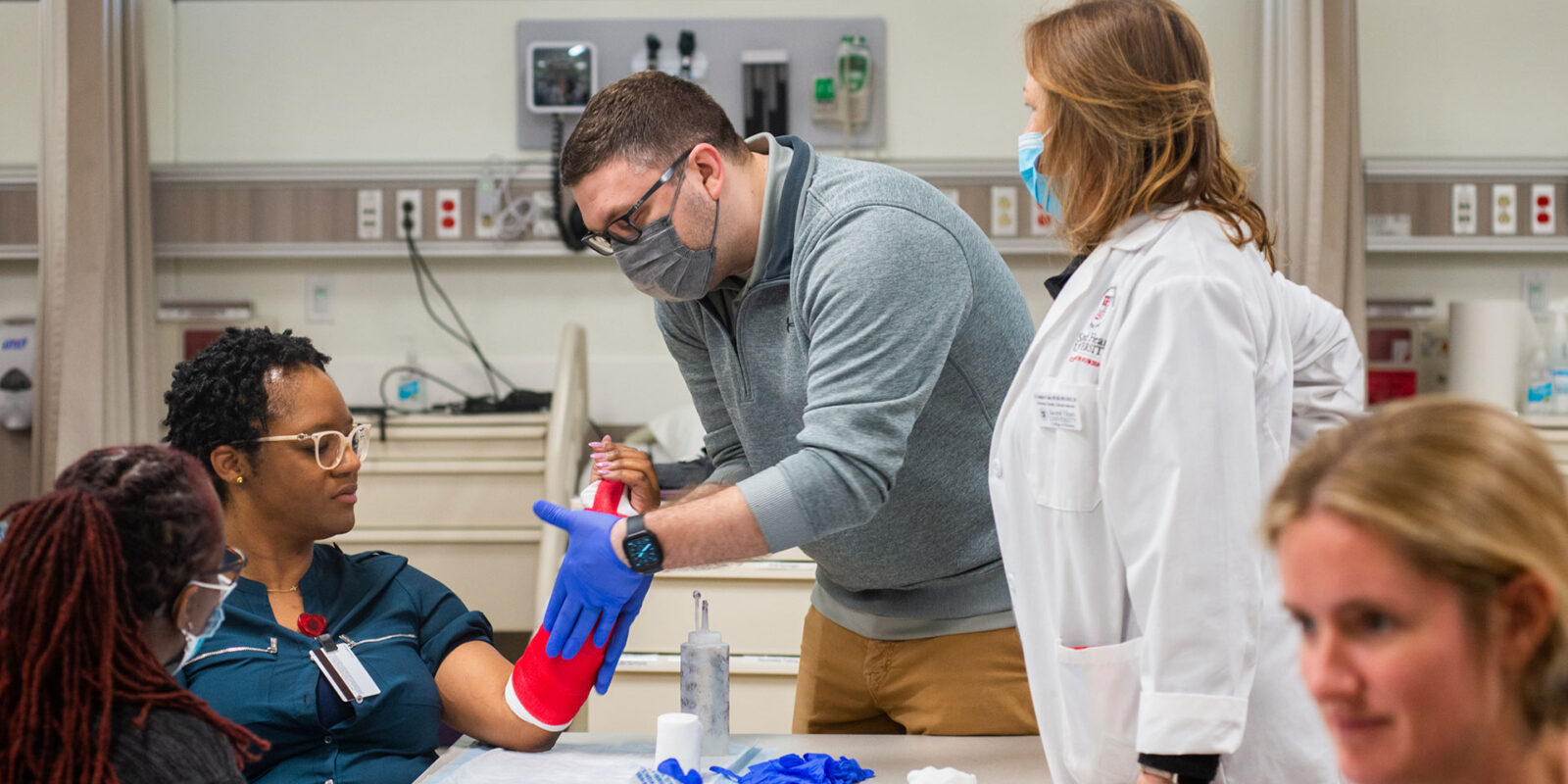
Advance Into Education to Empower the Next Generation of Nurses
Online with a Practicum
2-Year Duration
39 Credit Hours
$695 per Credit
Learn More Today
Complete the form to learn more about this program.
Our Online MSN: Nursing Education Program Prepares You for a Rewarding Career
- 2 start dates per year
- No GRE/GMAT requirements
Become an inspiring mentor and educator by completing the online master’s in nursing education program with Sacred Heart University. Among the most respected online MSN: Nursing Education degrees, our program positions you for success in nursing education while helping you meet the requirements to sit for the Certified Nurse Educator (CNE) exam.
While completing this online program, you’ll learn from expert faculty and work with a preceptor through three immersions to apply theory to practice. Take this opportunity to transition into a teaching role that helps address the ongoing nursing faculty shortage affecting nursing schools nationwide, according to the American Association of Colleges of Nursing (AACN).1
CCNE Accredited
The baccalaureate degree program in nursing, the master’s degree program in nursing, the Doctor of Nursing Practice, and the post-graduate APRN certificate program at Sacred Heart University are accredited by the Commission on Collegiate Nursing Education, 655 K Street, NW, Suite 750, Washington, DC 20001, 202-887-6791.
Online MSN: Nursing Education Details
- Take courses that align with the National League for Nursing (NLN) Core Competencies for Academic Nursing Educators
- Build curriculum development skills rooted in evidence-based practice
- This online program is modeled after the AACN Essentials for Master’s Education in Nursing
Learn From Faculty Who Emphasize Excellence in Education
Sacred Heart’s online MSN: Nursing Education program includes eight specialization courses that explore curriculum development and evaluation, the principles of patient and staff learning and the theoretical foundations of nursing education. You will also complete core courses that immerse you in health care policy, practice and research to build well-rounded skills while completing the online master’s in nursing education program.
If you’re interested in expanding your worldview alongside your nursing skills, consider taking an optional two-week term at SHU’s Dingle, Ireland campus during this online program. Through this experience, you will complete part of the capstone hours while being mentored by College of Nursing faculty abroad. Choose this option to participate in an integrated nursing module with other aspiring nursing students at a local college and a clinical site visit as you learn about the local Irish culture.
To deliver a truly rigorous, up-to-date education, we’ve designed the online MSN: Nursing Education program according to the NLN Core Competencies for Academic Nursing Educators and the AACN Essentials for Master’s Education in Nursing.
MSN: Nursing Education Required Courses
This course further prepares each student to assess in-depth the pathophysiology of common disease states. Clinical pathology content addresses alterations in major body systems that are commonly found in the primary care settings, as well as common testing used in the diagnostic process. This course assists the student in the role of advanced practice nurse with the preparation to assess clients across the lifespan.
This course prepares the learner to assess in depth the biopsychosocial health status of clients across the lifespan by obtaining a complete and accurate health history and by performing a systematic physical examination. Acquired data will be used to formulate a comprehensive problem list for the client and to refine documentation skills. Content will be designed to provide correlation of assessment strategies with an understanding of the mechanisms of illness and health problems of the main body systems. Health and wellness in the context of disability will be addressed. This course assists in the socialization of the learner into the role of the clinical nurse leader or nurse educator in the current healthcare delivery system. The simulation component enables the learner to develop comprehensive assessment and patient education skills and empathy.
Prerequisite: NU 602
This course covers research-based educational theory and evidence-based teaching/learning strategies. The theories will be examined for their application in a variety of settings, level of education, and for the adult learner. This course will introduce the impact of diversity and emphasis is placed on who the learner is and how he/she learns. External issues and trends impacting nursing education in a variety of teaching settings (face-to-face, virtual, and clinical) will be explored including ethical/legal considerations in course curriculum design and implementation.
This course prepares the student to design and implement curriculum based on evidence-based teaching/learning theory. Focus is on the process of curriculum development for an individual course including course objectives, content, learning activities, delivery of the content and student evaluation. The role of the faculty in program evaluation of the curriculum is explored.
This course will focus on the pharmacotherapeutic principles of drugs most commonly used and evaluated by Master’s prepared nurse across healthcare settings. Basic pharmacological concepts, including pharmacokinetics, pharmacodynamics, and pharmacotherapeutics, as well as the principle classifications of drugs in clinical use today are discussed in relation to physiologic and psychologic concepts. The role of the Master’s prepared nurse in teaching patients safe and effective medication administration and assessment of medication management and patients with chronic disease is emphasized. A variety of interactive and experiential activities will be utilized to enable the student to apply pharmacological theory to clinical situations and patient education.
The focus of the course is to explore the master’s prepared nurse’s role in education in a hospital or clinical setting. Theory and research based knowledge in the design, coordination, and evaluation of the delivery of patient care and staff education will be reviewed. Communication skills and strategies necessary to interact and collaborate with members of the interdisciplinary health care team in addition to develop a therapeutic alliance with the patient will be discussed.
This is the first course in the nursing sequence for the role immersion experience in nursing education. Students apply and analyze the theories, competencies, and concepts of the previous courses in a designated role practicum experience using a preceptor. Through this experience, the student will develop an evidence-based improvement teaching project. Current issues and trends in health care and nursing are integrated within each topical area. A practicum experience, that may involve direct patient care, is a required part of this course.
Prerequisite: NU 619
This is the final course in the nursing sequence for the role immersion experience in nursing education. Students apply and analyze the theories, competencies, and concepts of the previous courses in a designated role practicum experience using a preceptor. Through this experience the student will develop an evidence-based improvement teaching project. Current issues and trends in health care and nursing are integrated within each topical area. A practicum experience, that may involve direct patient care, is a required part of this course.
Prerequisite NU 690
In addition to the specialization requirements, you’ll take core courses to acquire foundational knowledge for advanced nursing roles. Taught by our experienced faculty, these courses explore health care policy, the principles of health care research, evidence-based practice and beyond.
View Program CurriculumFocus on Shaping the Future of Nursing in Your Career
Postsecondary nursing instructor employment is projected to grow 17% from 2024 to 2034 — much faster than average.2 With our online MSN: Nursing Educator program, you can prepare to meet this demand by developing skills for positions in colleges and universities, community health agencies and hospital-based schools of education. Nursing education roles are critically important, as you will offer valuable training to help reverse RN shortages expected to impact this field through 2030.3
Postsecondary Nursing Instructor $79,940 Median Annual Salary2
Nurse Educator $87,172 Average Annual Salary4
Faculty: Accomplished and Accessible
In your MSN online program, you will work directly with doctorally prepared faculty members with years of experience in their nursing specialties, extensive scholarly credentials and cutting-edge knowledge from the field. In addition to being well-versed in online teaching, our award-winning professors are available to answer your questions and offer support as you take the next step in your nursing journey.

Susan Penque, Associate Clinical Professor & Chair, Graduate Nursing Programs
Faculty Spotlight: Susan Penque, Ph.D., ANP-BC, NE-BC, NC-C
Sue Penque, Ph.D., APRN, ANP, NE, is the chair of graduate nursing programs at Sacred Heart University and associate clinical professor for the BSN-DNP/hybrid program. Penque is an accomplished leader with extensive background in patient care operations, strategic planning interprofessional collaboration, quality improvement and teaching. Penque is recognized for her vision, innovation, people skills, team building, achieving outcomes and her ability to lead an organization through major change.
Degrees & Certifications
- Ph.D. in nursing: University of Minnesota, Minneapolis, MN
- ANP certificate: College of St. Catherine, St. Paul, MN
- MSN adult and geriatric nursing: Adelphi University, Garden City, NY
- BSN: LIU, Post, Brookville, NY
- ANP: ANCC
- NE: ANCC
- NC: AHNCC
- TOC: Quality Matters
Research Interests
- Mindfulness and nursing practice
- Leadership
- Cardiovascular nursing practice
Awards & Fellowships
- Who’s Who in Women in Professional Services
- Dora Stohl Nursing Leadership Fellowship
- Rahr Fellowship in Nursing Research
- Helen Wells Nursing Research Award
- Cardiovascular Fellow, Healthcare Forum American Hospital Association
- Health One Hero Award, Health One Systems, Minneapolis, Minnesota
- Critical Care Nurse of the Year Award, Twin Cities Chapter AACN
- Good Neighbor Award, WCCO
- Sigma Theta Tau Nurse Excellence
What You’ll Learn
Sacred Heart’s MSN program delivers competencies that you’ll need to excel in today’s diverse health care community. Through the core and specialization courses, you can prepare to improve patient outcomes, pursue nurse practitioner positions, lead nursing teams and teach in clinical settings.
Program Learning Outcomes
- Translate into action the knowledge from philosophical and theoretical traditions of nursing science and other disciplinary perspectives to facilitate the ethical integration of evidence-based practice to advance nursing scholarship.
- Lead collaboratively within the interprofessional team to develop and evaluate plans of care with evidence-based, person-centered care principles promoting quality and safety outcomes.
- Collaborate with strategic partners to implement health policy while advocating for equitable and sustainable population health care.
- Integrate complex systems-based practice to develop innovative and evidence-supported equitable solutions to improve health outcomes across the lifespan of diverse populations.
- Apply best practices of informatics and communication technologies in diverse care settings to collect, analyze and synthesize data to promote quality and safe health care outcomes.
- Demonstrate professional behaviors reflecting current regulations, policies and practice integrating professional concepts, including ethics, compassion, diversity, equity and inclusion.
- Model leadership within the nursing profession that embraces self-care, a spirit of inquiry, advocacy, change, mentorship and service to others.
Explore More MSN Specializations
We offer additional MSN specializations to deliver the specific nursing expertise your goals demand. Explore these options to embark on your journey to becoming a nurse practitioner, educator or leader.
Frequently Asked Questions
If you have a question we don’t cover here, request more information or call 877-791-7181.
Yes. SHU’s MSN is accredited by the Commission on Collegiate Nursing Education (CCNE), the U.S. Department of Education–recognized gold standard for graduate nursing program accreditation. CCNE accreditation has three concrete implications for graduates: (1) FNP and PMHNP completers must hold a degree from a CCNE-accredited program to sit for national certification exams through ANCC or AANPCB; (2) the credential is accepted across all 50 states, ensuring licensing board eligibility wherever you practice; and (3) most healthcare employers require CCNE accreditation when evaluating APRN candidates for advanced practice roles.
The baccalaureate degree program in nursing, the master’s degree program in nursing, the Doctor of Nursing Practice, and the post-graduate APRN certificate program at Sacred Heart University are accredited by the Commission on Collegiate Nursing Education, 655 K Street, NW, Suite 750, Washington, DC 20001, 202-887-6791.
Sacred Heart accepts 6–12 transfer credits into the online MSN depending on specialization, a meaningful reduction in both total credit load and overall program cost for nurses with relevant prior graduate coursework. Transfer credits must come from a regionally accredited institution and be relevant to the curriculum of the chosen specialization. The admissions team evaluates transfer transcripts on a case-by-case basis, so running your prior graduate coursework through SHU’s evaluation process before enrollment is the most reliable way to determine your actual credit requirement and estimated total tuition.
SHU’s online MSN opens five distinct advanced nursing career pathways (Family Nurse Practitioner, Psychiatric Mental Health NP, Clinical Nurse Leader, Nursing Educator, and Nursing Executive), with average annual salaries ranging from approximately $90,000 to $132,000+. FNP and PMHNP graduates earn a BLS-reported median of ~$132,050 (May 2024), with APRN employment projected to grow 35% through 2034. Nursing Management and Executive roles at large health systems can exceed $140,000 at senior levels, while Nursing Education positions typically offer $80,000–$100,000 with significant schedule flexibility.
Sacred Heart’s Family Nurse Practitioner (FNP) specialization prepares graduates to diagnose, treat, and manage acute and chronic conditions across the lifespan in primary care settings. The Psychiatric Mental Health NP (PMHNP) specialization focuses on mental health assessment, psychiatric diagnosis, and psychopharmacological management for patients with behavioral health conditions, one of the fastest-growing advanced practice roles in the U.S. Both tracks carry the same per-credit rate ($955) and total tuition (~$40,110), include on-campus residencies, and prepare graduates for certification through ANCC or AANPCB. The key differentiator is clinical setting and patient population.
Yes. Sacred Heart’s online MSN is built for working nurses, with all core coursework delivered asynchronously across a flexible 2–6 year completion window. Students choose their term-by-term course load based on professional demands, scaling up during lighter clinical seasons and back during busier periods. Clinical hours for most specializations are completed at a facility near you (many students use their current employer), eliminating the need to relocate or take extended leave. FNP and PMHNP students should also account for on-campus residency components at SHU’s Fairfield, CT campus when planning their schedule.
Sacred Heart’s online MSN can be completed in as few as 2–2.5 years on the accelerated track, with most working nurses finishing in 3–4 years and a maximum completion window of 6 years, giving students significant flexibility to manage both academic and professional demands. Credit requirements range from 36–42 hours depending on specialization: NP tracks (FNP, PMHNP) take longer due to clinical hour minimums and residency requirements, while non-NP tracks such as Nursing Education and Nursing Management are generally completed on a shorter timeline. Students can adjust their course load term by term without formal approval.
Sources
- American Association of Colleges of Nursing. “Nursing Faculty Shortage Fact Sheet.” Retrieved July 8, 2025, from https://www.aacnnursing.org/news-data/fact-sheets/nursing-faculty-shortage.
- Bureau of Labor Statistics, U.S. Department of Labor. Occupational Outlook Handbook. “Postsecondary Teachers.” Retrieved Sept. 23, 2025, from https://www.bls.gov/ooh/education-training-and-library/postsecondary-teachers.htm.
- American Association of Colleges of Nursing. “Nursing Shortage Fact Sheet.” Retrieved July 8, 2025, from https://www.aacnnursing.org/news-data/fact-sheets/nursing-shortage.
- Payscale. “Average Nurse Educator Salary.” Retrieved Sept. 23, 2025, from https://www.payscale.com/research/US/Job=Nurse_Educator/Salary.